What was the "muck" they exposed to Americans during the Progressive Era?
 The publication of Upton Sinclair'southward 1906 novel The Jungle produced an immediate and powerful upshot on Americans and on federal policy, merely Sinclair had hoped to achieve a very different event. At the time he began working on the novel, he had completed his studies at Columbia University and was trying to develop a career as an author. He had been born in Baltimore in 1878, but his family had moved to the Bronx in 1888. Though he came from a prominent family, his own parents had little coin, and he paid for his academy studies by writing dime novels and short stories. While at Columbia, he also became a convert to socialism.
At the time, journalists had begun to play an of import part in exposing wrongdoing. Effectually 1902, magazine publishers discovered that their sales soared when they featured exposés of political corruption, corporate misconduct, or other offenses. McClure's Magazine led the way, in Oct 1902, with a series by Lincoln Steffens that revealed corruption in city governments. In Jan 1903, McClure'southward carried Steffens's installment on Minneapolis, launched a new serial by Ida Tarbell on Standard Oil, and featured an article on corruption in labor unions. McClure's sales boomed, and other publications quickly commissioned exposés of their own.
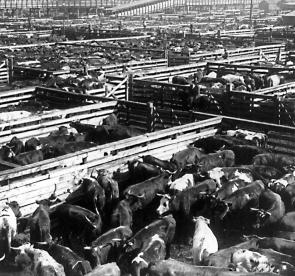
In 1904, the leading socialist weekly in the land, the Appeal to Reason, offered Sinclair $500 (equivalent to near $xi,500 in 2008) to fix an exposé on the meatpacking industry. Upon arriving in his hotel in Chicago, Sinclair is said to have announced, "I am Upton Sinclair, and I have come to write the Uncle Tom'due south Cabin of the labor movement." For 7 weeks, he prowled the streets of Packingtown, the residential commune next to the stockyards and packing plants. He donned overalls, posed as a worker, and slipped into the packing plants to gain firsthand knowledge of the piece of work. He sought out social workers, police officers, physicians, and others who could tell him virtually life and piece of work in Packingtown. Local socialists introduced him to other people who were knowledgeable virtually the community and the piece of work. At the terminate of seven weeks, he returned abode to New Jersey, close himself upwards in a modest cabin, and wrote for ix months.
The book he produced, The Jungle, followed a fictional family of Lithuanian immigrants in Chicago. From an opening chapter that recounts the joyous nuptials of the main grapheme, Jurgis Rudkus, Sinclair traced the family's feel with piece of work in Packingtown. In the process, he exposed in icky detail the inner workings of the meatpacking manufacture:
They were regular alchemists at Durham'due south; they advertised a mushroom-catsup, and the men who made it did not know what a mushroom looked like. They advertised 'potted chicken' . . . the things that went into the mixture were tripe, and the fat of pork, and beefiness suet, and hearts of beefiness, and finally the waste ends of veal, when they had any. They put these upwards in several grades, and sold them at several prices; simply the contents of the cans all came out of the same hopper. And then there was 'potted game' and 'potted bickering,' 'potted ham,' and 'deviled ham'—de-vyled, as the men called it. 'De-vyled' ham was made out of the waste ends of smoked beef that were likewise minor to be sliced by the machines; and besides tripe, dyed with chemicals and then that it would not evidence white; and trimmings of hams and corned beef; and potatoes, skins and all; and finally the hard cartilaginous gullets of beef, later on the tongues had been cut out. All this ingenious mixture was footing upwardly and flavored with spices to make it taste like something.
Sinclair described the afflictions of packinghouse workers, from severed fingers to tuberculosis and claret poisoning. He wrote of men who "vicious into the vats; and when they were fished out, at that place was never plenty left of them to be worth exhibiting—sometimes they would be overlooked for days, till all but the bones of them had gone out to the world equally Durham'due south Pure Leaf Lard!" And he told of scheming real-estate salesmen and crooked politicians.
At the eye of the story, Sinclair recounts the destruction of Jurgis'southward family because of the corrupt, exploitative, and oppressive nature of work and life in Packingtown. Finally Jurgis is left alone, stripped of all nobility. 1 evening, he wanders into a meeting hall to escape the cold, hears a speech on socialism, and becomes an ardent convert to that cause. The terminal section of the novel features arguments for socialism, in the class of speeches that Jurgis hears. The book ends with a socialist orator'due south impassioned appeal to "Organize! Organize! Organize!" so that "Chicago will be ours! Chicago volition exist ours! CHICAGO WILL BE OURS!"
Sinclair's work broke with the mold established by previous exposés in two ways. First, his was a piece of work of fiction that followed 1 family over a period of years and, in the procedure, detailed unsanitary food preparation, exploitation of workers, sleazy existent-manor practices, political corruption, and much more. Second, where many previous authors had suggested that the reform of the abuses they described could be accomplished past the ballot of honest men, Sinclair had a larger goal: the rejection of capitalism and the victory of socialism. He intended that his readers would recognize that the horrors portrayed in his book were the consequence of corporate greed and exploitation and that the meatpacking industry was but a microcosm of capitalism—that the jungle was actually industrial capitalism. In the serialized version, he stated: "the place which is here chosen The Jungle is non Packingtown, nor is information technology Chicago, nor is it Illinois, nor is it the U.s.a.—it is Civilisation."
In late February 1905, the Appeal to Reason began to publish Sinclair's piece of work as a serial, one chapter per calendar week, and the newspaper's sales boomed to 175,000 per issue. Betwixt April and October, the consummate version also appeared in four installments in a small, socialist quarterly magazine called One-Hoss Philosophy. The novel drew praise from prominent Socialists, including the best-selling novelist Jack London. But Sinclair wanted his work to attain the widest possible audience. Just as Steffens'due south and Tarbell'south works had appeared as books, then Sinclair intended his novel to be a book. He beginning approached Macmillan, the publisher of his previous novel, a Civil War story chosen Manassas. Though initially interested, Macmillan somewhen backed off. According to Sinclair, five other publishers did the same. Equally he went to publisher afterward publisher, he was besides revising the version that had appeared in serial form, trimming it, removing duplicative fabric, modifying the final capacity, improving his utilise of Lithuanian phrases, and modifying textile that might have invited a lawsuit for libel. Discouraged almost finding a publisher, he finally asked the readers of the Appeal to Reason to contribute funds to enable him to publish it himself. Just as he was almost to begin his self-publishing venture, he received an acceptance from Doubleday, Folio and Company.
Like other publishers, Doubleday had been concerned for the possibility of legal liability if the packing companies were to sue. Their offer to publish was contingent on their power to verify the truth of Sinclair'south descriptions of the packing plants. One of their editors went to Chicago and interviewed a erstwhile governmental meat inspector, who confirmed that Sinclair's version was not exaggerated. Non satisfied, the editor secured an inspector's badge and prowled through the vast packing plants. His conclusion: things were as bad every bit Sinclair had reported, perhaps worse. The book was released on January 25, 1906, and created an international sensation, selling 25,000 copies in six weeks. It has never been out of impress and was made into a movie in 1913.
The stir created past The Jungle quickly reached all the fashion to the White Firm. The nation's leading political humorist, Finley Peter Dunne, who wrote in the character of a Chicago saloonkeeper named Mr. Dooley, imagined the reaction of President Theodore Roosevelt:
Tiddy was toying with a light breakfast an' idly turnin' over th' pages 4 thursday' new book with both hands. Suddenly he rose fr'thousand th' tabular array, an' cryin': "I'm pizened," began throwin' sausages out four th' window. . . . Since thin th' Prisidint, like th' rest iv u.s.a., has become a viggytaryan.
In fact, Roosevelt behaved quite differently. His commencement reaction was to consult with the Agriculture Department, which reported that meatpacking was carefully inspected and meat was safe to eat. Roosevelt then wrote to Frank Doubleday, berating him for publishing "such an obnoxious book." Doubleday replied that his visitor had confirmed Sinclair'due south descriptions. Roosevelt launched his own investigation, which confirmed, in Roosevelt's words, that "the method of treatment and preparing food products is uncleanly and unsafe to health," but he announced but that he had the report and did not release its contents.
Congress at the time was because a pure-food-and-drug bill, the result of a serial of earlier exposés of patent medicines and impure foods too every bit continued lobbying by Harvey Wiley of the Bureau of Chemical science in the Agriculture Department and force per unit area from such groups as the American Medical Clan. Roosevelt himself, in his 1905 message to Congress, had recommended action on the subject. Notwithstanding, conservative opposition to whatever regulation combined with opposition from drug and food-processing companies seemed likely to defeat the bill. The public outcry created by The Jungle inverse the dynamic in Congress. The Senate approved the pure-food-and-drugs bill in late February by a vote of 63 to 4. Nevertheless, the pure-nutrient-and-drugs bill included no provision for meat inspection. Accordingly, Senator Albert Beveridge of Indiana, a progressive Republican, proposed legislation requiring federal inspection of all meat that moved in interstate commerce and directing the Department of Agriculture to regulate conditions in the packinghouses. Beveridge described his nib as "the most pronounced extension of federal ability in every management ever enacted." Roosevelt, still withholding his report, threatened to release it unless the Senate took action on Beveridge'southward bill. The Senate approved the bill.
The meat packers at present joined other food-processing companies in focusing on the House of Representatives, where both bills at present lay. When powerful Business firm members sought to dilute the Beveridge beak, Roosevelt released the written report, which, he proclaimed, clearly demonstrated that conditions in the stockyards were "revolting." The strategy did not work. Opposition continued. Finally a compromise emerged—Beveridge's bill had provided that a fee would be assessed on every animate being slaughtered, to pay for the inspection and regulation, but the compromise specified that the costs would be borne by the federal regime; Beveridge had wanted a appointment to be stamped on all canned meat, but the compromise omitted any requirement for dating. Withal, Beveridge and Roosevelt agreed that the compromise was improve than no regulation at all. Roosevelt signed both the Meat Inspection Deed and the Pure Nutrient and Drug Act into police force on June xxx, 1906. He described those 2 laws, together with a bill to regulate railroad rates, every bit marker "a noteworthy advance in the policy of securing Federal supervision and control over corporations." Historians have agreed with Roosevelt's assay, citing the three bills passed in 1906 equally major early on steps in the evolution of federal regulation of a wide range of economic action.
Though less than six months had passed from Doubleday'due south publication of The Jungle to the signing of the Meat Inspection Act, Sinclair was disappointed that his book had produced but a federal constabulary regulating meatpackers and not a surge of popular support for socialism. "I aimed at the public's heart," he famously observed, "and by accident I striking it in the stomach." Though the book failed to create a surge of converts to socialism, information technology was very practiced for Upton Sinclair, who, at the age of 20-8, catapulted into international prominence. Sinclair'south career as an author was both long and productive. Past the time of his death in 1968, he had written more than 90 books, with translations into about 50 languages, and had won a Pulitzer Prize. He had dabbled in politics as a Socialist until 1934, when he changed his party registration and won the Democratic nomination for governor of California. His campaign was based on a programme he called EPIC (Stop Poverty in California), but he lost when his Republican opponent mounted a highly sophisticated, media-based negative campaign that some scholars have seen as the origins of modern media-driven campaigns.
Theodore Roosevelt remained unhappy with the constant journalistic exposés. In the midst of the controversy over meatpacking, on April 14, 1906, he gave a spoken language that has go known as "The Man with the Muck-Rake." In that oral communication, he discussed journalists who specialized in exposés:
In Bunyan's "Pilgrim'southward Progress" you may recollect the description of the Man with the Muck-rake, the man who could wait no way only downward, with the muck-rake [manure rake] in his hand; who was offered a celestial crown for his muck-rake, just who would neither look up nor regard the crown he was offered, but continued to rake to himself the filth of the floor.
In "Pilgrim'due south Progress" the Homo with the Muck-rake is set forth as the case of him whose vision is stock-still on lecherous instead of on spiritual things. Nevertheless he besides typifies the man who in this life consistently refuses to see nada that is lofty, and fixes his eyes with solemn intentness only on that which is vile and debasing.
Roosevelt intended his speech communication every bit a rebuke to those, every bit he said, who engaged in "gross and reckless assaults on character," and non to those who engaged in the "relentless exposure of and assault upon every evil man whether political leader or business human being, every evil practice, whether in politics, in business organization, or in social life." However, information technology was the metaphor of the Man with the Muck-rake that captured public attention. Though Roosevelt intended his comparison as an insult, the championship "muckraker" was taken upward by many journalists as a bluecoat of honor.
The modernistic Food and Drug Administration dates to the regulatory functions assigned to the Bureau of Chemistry of the Agronomics Section past the Pure Food and Drug Act of 1906. In 1938, Congress significantly expanded the regulatory functions of the 1906 law and extended FDA's authority over processed foods. In 1990 Congress passed the Nutrition Labeling and Education Act, which required nutrient products, including processed meat, to provide basic nutritional information. Today, though many manufacturers at present include dates on their food products, in that location is still no agreed upon standard for the dating of food products. And today the media still carries occasional stories of contaminated nutrient products, both meat and vegetables, that have caused sickness and even death, or of the discovery in the food concatenation of an animal infected with bovine spongiform encephalopathy (BSE), commonly known as mad-cow disease.
Reading The Jungle
The Jungle continues to exist in print, in ii dissimilar versions. All but one edition now in impress are based on the 1906 Doubleday version. Among these, the edition published by the University of Illinois Press in 1988 provides a useful introduction by the historian James R. Barrett, in which he explores some of the aspects of life in Packingtown in the early twentieth century that Sinclair missed. The edition published by Bedford/St. Martin's Press in 2005 includes both an introduction by the historian Christopher Phelps and also the study ordered by President Theodore Roosevelt.
The other version of the book appears in just ane of the editions that are currently in print, published by See Sharp Press in 2003. This edition is based on the serialized text published in One-Hoss Philosophy in 1905. In its introduction, Kathleen De Grave, a literature professor, argues that the Doubleday version represents a "bottom book" than the serialized version and that Sinclair felt compelled to conscience himself to secure commercial publication; she also implies that the Doubleday version was "produced nether compulsion, directly or indirectly, for political or economic reasons." Barrett and Phelps dispute these conclusions, arguing that there is no clear evidence that Sinclair's revisions were anything more than an effort to prepare a sprawling serial for publication as a book. Phelps also points out that, after 1906, the book was published in numerous editions during Sinclair'southward lifetime, including four self-published editions, but that Sinclair never sought to restore any of the text he'd cut or altered. For Phelps'due south argument, see "The Fictitious Suppression of Upton Sinclair's The Jungle," History News Network, June 26, 2006.
Robert W. Cherny is Professor of History at San Francisco State University. His books include California Women and Politics: From the Gold Rush to the Bang-up Low(2011) with co-editors Mary Ann Irwin and Ann Marie Wilson; American Labor and the Cold War: Unions, Politics, and Postwar Political Culture (2004) with co-editors William Issel and Keiran Taylor; and American Politics in the Gilded Age, 1868–1900 (1997).
Source: http://ap.gilderlehrman.org/history-by-era/politics-reform/essays/jungle-and-progressive-era
0 Response to "What was the "muck" they exposed to Americans during the Progressive Era?"
Post a Comment