Discuss the Indus Valley Civilization in Regard to Their Location Architecture and Art Forms
The Indus Valley Civilization was a cultural and political entity which flourished in the northern region of the Indian subcontinent between c. 7000 - c. 600 BCE. Its modernistic proper noun derives from its location in the valley of the Indus River, merely information technology is also commonly referred to as the Indus-Sarasvati Civilisation and the Harrapan Civilisation.
These latter designations come up from the Sarasvati River mentioned in Vedic sources, which flowed adjacent to the Indus River, and the ancient urban center of Harappa in the region, the first ane found in the modern era. None of these names derive from any aboriginal texts because, although scholars generally believe the people of this civilization developed a writing system (known as Indus Script or Harappan Script) information technology has not yet been deciphered.
All three designations are modern constructs, and nothing is definitively known of the origin, development, turn down, and autumn of the civilization. Fifty-fifty so, modern archaeology has established a probable chronology and periodization:
- Pre-Harappan – c. 7000 - c. 5500 BCE
- Early Harappan – c. 5500 - 2800 BCE
- Mature Harappan – c. 2800 - c. 1900 BCE
- Late Harappan – c. 1900 - c. 1500 BCE
- Mail service Harappan – c. 1500 - c. 600 BCE
The Indus Valley Civilization is now ofttimes compared with the far more famous cultures of Egypt and Mesopotamia, but this is a fairly recent development. The discovery of Harappa in 1829 CE was the commencement indication that whatever such civilisation existed in India, and past that time, Egyptian hieroglyphics had been deciphered, Egyptian and Mesopotamian sites excavated, and cuneiform would soon be translated by the scholar George Smith (l. 1840-1876 CE). Archaeological excavations of the Indus Valley Civilization, therefore, had a significantly belatedly start comparatively, and information technology is now thought that many of the accomplishments and "firsts" attributed to Arab republic of egypt and Mesopotamia may actually belong to the people of the Indus Valley Civilization.
The total population of the civilization is thought to have been upward of five million, & its territory stretched over 900 miles (1,500 km) along the Indus River.
The two best-known excavated cities of this culture are Harappa and Mohenjo-daro (located in modern-day Islamic republic of pakistan), both of which are thought to have one time had populations of between 40,000-50,000 people, which is stunning when one realizes that most ancient cities had on boilerplate 10,000 people living in them. The total population of the civilization is thought to accept been upward of 5 million, and its territory stretched over 900 miles (1,500 km) along the banks of the Indus River and so in all directions outward. Indus Valley Civilization sites accept been plant near the border of Nepal, in Afghanistan, on the coasts of India, and around Delhi, to name merely a few locations.
Between c. 1900 - c. 1500 BCE, the civilisation began to decline for unknown reasons. In the early 20th century CE, this was idea to have been caused by an invasion of lite-skinned peoples from the north known as Aryans who conquered a nighttime-skinned people defined by Western scholars every bit Dravidians. This claim, known as the Aryan Invasion Theory, has been discredited. The Aryans – whose ethnicity is associated with the Iranian Persians – are now believed to have migrated to the region peacefully and composite their culture with that of the indigenous people while the term Dravidian is understood at present to refer to anyone, of any ethnicity, who speaks one of the Dravidian languages.
Why the Indus Valley Civilization declined and brutal is unknown, but scholars believe it may accept had to do with climate change, the drying up of the Sarasvati River, an amending in the path of the monsoon which watered crops, overpopulation of the cities, a reject in trade with Egypt and Mesopotamia, or a combination of any of the above. In the present day, excavations keep at many of the sites establish thus far and some future observe may provide more than information on the history and decline of the civilization.
Discovery & Early Digging
The symbols and inscriptions on the artifacts of the people of the Indus Valley Culture, which have been interpreted by some scholars as a writing system, remain undeciphered and and so archaeologists generally avert defining an origin for the culture as any try would exist speculative. All that can be known of the civilization to appointment comes from the physical evidence excavated at diverse sites. The story of the Indus Valley Culture, therefore, is best given with the discovery of its ruins in the 19th century CE.
James Lewis (better known equally Charles Masson, l. 1800-1853 CE) was a British soldier serving in the arms of the East India Company Army when, in 1827 CE, he deserted with another soldier. In social club to avoid detection by regime, he changed his proper noun to Charles Masson and embarked on a series of travels throughout India. Masson was an avid numismatist (coin collector) who was especially interested in sometime coins and, in following various leads, wound up excavating ancient sites on his own. One of these sites was Harappa, which he establish in 1829 CE. He seems to have left the site fairly quickly, after making a record of it in his notes but, having no knowledge of who could accept built the city, wrongly attributed it to Alexander the Great during his campaigns in Bharat c. 326 BCE.
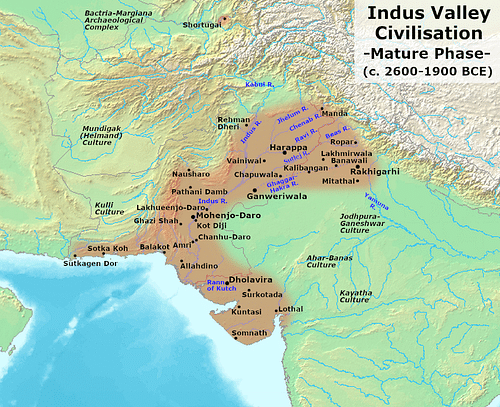
Indus Valley Civilization - Mature Harappan Stage
When Masson returned to Britain subsequently his adventures (and having been somehow forgiven his desertion), he published his book Narrative of Diverse Journeys in Balochistan, Afghanistan and the Punjab in 1842 CE which attracted the attention of the British authorities in Republic of india and, specially, Alexander Cunningham. Sir Alexander Cunningham (l. 1814-1893 CE), a British engineer in the country with a passion for aboriginal history, founded the Archaeological Survey of India (ASI) in 1861 CE, an organization dedicated to maintaining a professional standard of excavation and preservation of historic sites. Cunningham began excavations of the site and published his estimation in 1875 CE (in which he identified and named the Indus Script) but this was incomplete and lacked definition because Harappa remained isolated with no connectedness to whatsoever known past civilisation which could take congenital it.
In 1904 CE, a new managing director of the ASI was appointed, John Marshall (l. 1876-1958 CE), who subsequently visited Harappa and concluded the site represented an ancient civilization previously unknown. He ordered the site to be fully excavated and, at most the same time, heard of another site some miles away which the local people referred to as Mohenjo-daro ("the mound of the dead") considering of basic, both animal and human being, found there along with various artifacts. Excavations at Mohenjo-daro began in the 1924-1925 season and the similarities of the ii sites were recognized; the Indus Valley Civilization had been discovered.
Harappa & Mohenjo-daro
The Hindu texts known equally the Vedas, as well equally other peachy works of Indian tradition such as the Mahabharata and Ramayana, were already well known to Western scholars simply they did not know what culture had created them. Systemic racism of the time prevented them from attributing the works to the people of India, and the aforementioned, at get-go, led archaeologists to conclude that Harappa was a colony of the Sumerians of Mesopotamia or perhaps an Egyptian outpost.
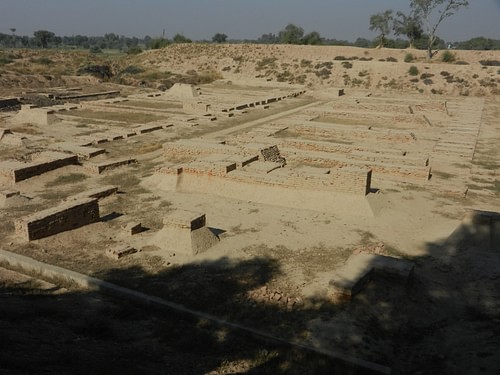
Harappa
Harappa did not conform to either Egyptian or Mesopotamian architecture, however, as there was no evidence of temples, palaces, or monumental structures, no names of kings or queens or stelae or royal statuary. The city spread over 370 acres (150 hectares) of small-scale, brick houses with apartment roofs made of dirt. In that location was a citadel, walls, the streets were laid out in a grid blueprint clearly demonstrating a high degree of skill in urban planning and, in comparing the ii sites, it was credible to the excavators that they were dealing with a highly advanced culture.
Houses in both cities had flush toilets, a sewer system, and fixtures on either side of the streets were function of an elaborate drainage system, which was more avant-garde fifty-fifty than that of the early Romans. Devices known from Persia as "wind catchers" were attached to the roofs of some buildings which provided air conditioning for the home or authoritative office and, at Mohenjo-daro, there was a corking public bath, surrounded past a courtyard, with steps leading down into it.
As other sites were unearthed, the same degree of sophistication and skill came to calorie-free as well as the understanding that all of these cities had been pre-planned. Unlike those of other cultures which ordinarily developed from smaller, rural communities, the cities of the Indus Valley Civilization had been idea out, a site chosen, and purposefully constructed prior to full habitation. Further, they all exhibited conformity to a unmarried vision which further suggested a stiff central government with an efficient hierarchy that could plan, fund, and build such cities. Scholar John Keay comments:
What amazed all these pioneers, and what remains the distinctive feature of the several hundred Harappan sites now known, is their apparent similarity: "Our overwhelming impression is of cultural uniformity, both throughout the several centuries during which the Harappan culture flourished, and over the vast area information technology occupied." The ubiquitous bricks, for instance, are all of standardized dimensions, simply as the rock cubes used by the Harappans to measure weights are also standard and based on the modular arrangement. Route widths adapt to a similar module; thus, streets are typically twice the width of side lanes, while the master arteries are twice or one and a half times the width of streets. Most of the streets so far excavated are direct and run either northward-south or e-west. City plans therefore suit to a regular grid pattern and announced to have retained this layout through several phases of building. (9)
Excavations at both sites continued betwixt 1944-1948 CE nether the direction of the British archeologist Sir Mortimer Wheeler (l. 1890-1976 CE) whose racialist ideology made it difficult for him to accept that dark-skinned people had built the cities. Even so, he managed to establish stratigraphy for Harappa and lay the foundation for the later on periodization of the Indus Valley Civilization.
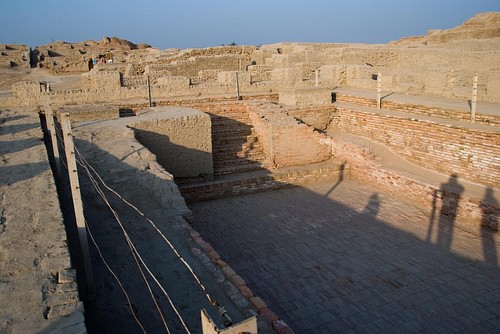
Smashing Bath, Mohenjo-daro
Chronology
Wheeler's work provided archaeologists with the means to recognize approximate dates from the culture's foundations through its reject and fall. The chronology is primarily based, as noted, on concrete testify from Harappan sites but too from noesis of their trade contacts with Egypt and Mesopotamia. Lapis lazuli, to proper noun only one product, was immensely popular in both cultures and, although scholars knew it came from Republic of india, they did non know from precisely where until the Indus Valley Civilization was discovered. Fifty-fifty though this semi-precious stone would go on to be imported after the autumn of the Indus Valley Civilisation, it is articulate that, initially, some of the export came from this region.
- Pre-Harappan – c. 7000 - c. 5500 BCE: The Neolithic period best exemplified by sites like Mehrgarh which shows prove of agricultural development, domestication of plants and animals, and product of tools and ceramics.
- Early Harappan – c. 5500-2800 BCE: Trade firmly established with Arab republic of egypt, Mesopotamia, and possibly Mainland china. Ports, docks, and warehouses built near waterways past communities living in small villages.
- Mature Harappan – c. 2800 - c. 1900 BCE: Construction of the great cities and widespread urbanization. Harappa and Mohenjo-daro are both flourishing c. 2600 BCE. Other cities, such equally Ganeriwala, Lothal, and Dholavira are built according to the same models and this development of the country continues with the structure of hundreds of other cities until there are over 1,000 of them throughout the country in every direction.
- Late Harappan – c. 1900 - c. 1500 BCE: Decline of the culture coinciding with a wave of migration of the Aryan people from the due north, well-nigh likely the Iranian Plateau. Physical bear witness suggests climate alter which caused flooding, drought, and famine. A loss of trade relations with Arab republic of egypt and Mesopotamia has as well been suggested every bit a contributing crusade.
- Post Harappan – c. 1500 - c. 600 BCE: The cities are abased, and the people have moved south. The civilization has already fallen by the time Cyrus 2 (the Great, r. c. 550-530 BCE) invades India in 530 BCE.
Aspects of Culture
The people seem to have been primarily artisans, farmers, and merchants. There is no evidence of a standing ground forces, no palaces, and no temples. The Corking Bath at Mohenjo-daro is believed to accept been used for ritual purification rites related to religious belief but this is theorize; it could every bit easily have been a public pool for recreation. Each city seems to have had its own governor merely, information technology is speculated, there must have been some course of centralized regime in order to reach the uniformity of the cities. John Keay comments:
Harappan tools, utensils, and materials confirm this impression of uniformity. Unfamiliar with atomic number 26 – which was nowhere known in the tertiary millennium BC – the Harappans sliced, scraped, beveled, and bored with 'effortless competence' using a standardized kit of tools made from chert, a kind of quartz, or from copper and statuary. These concluding, forth with gold and silver, were the just metals available. They were also used for casting vessels and statuettes and for fashioning a diversity of knives, fishhooks, arrowheads, saws, chisels, sickles, pins, and bangles. (10)
Amongst the thousands of artifacts discovered at the various sites are small, soapstone seals a trivial over an inch (3 cm) in diameter which archaeologists interpret to take been used for personal identification in trade. Like the cylinder seals of Mesopotamia, these seals are thought to have been used to sign contracts, authorize state sales, and cosign point-of-origin, shipment, and receipt of appurtenances in trade long distance.
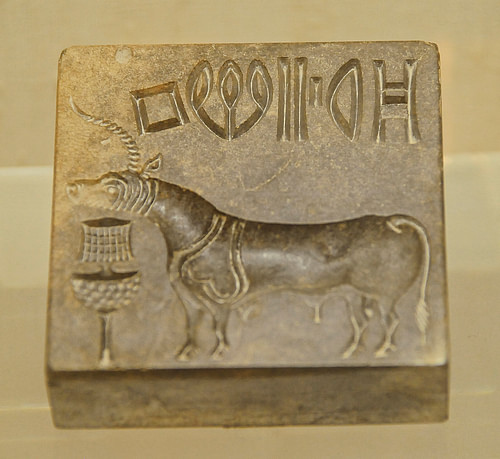
Unicorn Seal - Indus Script
The people had developed the wheel, carts drawn by cattle, flat-bottomed boats wide enough to transport trade goods, and may have also adult the sail. In agriculture, they understood and made use of irrigation techniques and canals, various farming implements, and established unlike areas for cattle grazing and crops. Fertility rituals may have been observed for a full harvest as well as pregnancies of women every bit evidenced past a number of figurines, amulets, and statuettes in female course. It is thought that the people may have worshipped a Mother Goddess deity and, perchance, a male person consort depicted as a horned effigy in the company of wild animals. The religious beliefs of the culture, however, are unknown and any suggestions must be speculative.
Their level of artistic skill is evident through numerous finds of statuary, soapstone seals, ceramics, and jewelry. The most famous artwork is the statuary statuette, standing 4 inches (10 cm) tall, known equally "Dancing Daughter" found at Mohenjo-daro in 1926 CE. The piece shows a teenage girl, correct hand on her hip, left on her knee, with mentum raised as though evaluating the claims of a suitor. An as impressive piece is a soapstone figure, vi inches (17 cm) tall, known equally the Priest-King, depicting a bearded man wearing a headdress and ornamental armband.
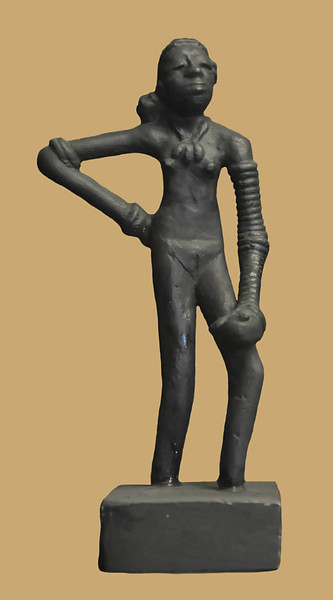
Dancing Daughter of Mohenjo-daro
A particularly interesting aspect of the artwork is the advent of what seems to exist a unicorn on over 60 percent of the personal seals. At that place are many different images on these seals but, every bit Keay notes, the unicorn appears on "1156 seals and sealings out of a total of 1755 found at Mature Harappan sites" (17). He also notes that the seals, no matter what image appears on them, also have markings which have been interpreted as Indus Script, suggesting that the "writing" conveys a meaning unlike from the image. The "unicorn" could possibly have represented an individual's family, clan, city, or political affiliation and the "writing" ane's personal information.
Decline & Aryan Invasion Theory
Only equally in that location is no definitive respond to the question of what the seals were, what the "unicorn" represented, or how the people venerated their gods, in that location is none for why the culture declined and fell. Between c. 1900 - c. 1500 BCE, the cities were steadily abased, and the people moved south. As noted, there are a number of theories concerning this, simply none are completely satisfactory. According to 1, the Gaggar-Hakra River, which is identified with the Sarasvati River from Vedic texts, and which ran adjacent to the Indus River, stale upwardly c. 1900 BCE, necessitating a major relocation of the people who had depended on information technology. Meaning silting at sites such every bit Mohenjo-daro suggests major flooding which is given as another crusade.
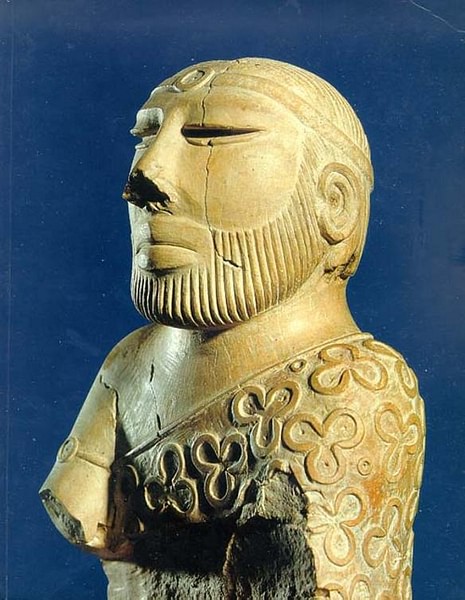
Priest-male monarch from Mohenjo-daro
Another possibility is a drib in necessary trade goods. Both Mesopotamia and Egypt were experiencing troubles during this aforementioned time which could have resulted in a significant disruption in trade. The Tardily Harappan Period corresponds roughly with the Middle Bronze Age in Mesopotamia (2119-1700 BCE) during which the Sumerians – the major trading partners with the people of the Indus Valley – were engaged in driving out the Gutian invaders and, betwixt c. 1792-1750 BCE, the Babylonian male monarch Hammurabi was conquering their city-states as he consolidated his empire. In Egypt, the period corresponds to the latter part of the Eye Kingdom (2040-1782 BCE) when the weak 13th Dynasty ruled simply prior to the coming of the Hyksos and the key government'southward loss of power and authority.
The reason which early on 20th century CE scholars seized on, however, was none of these but the claim that the Indus Valley people had been conquered and driven south by an invasion of a superior race of light-skinned Aryans.
Aryan Invasion Theory
Western scholars had been translating and interpreting the Vedic literature of India for over 200 years by the time Wheeler was excavating the sites and, in that fourth dimension, came to develop the theory that the subcontinent was at some signal conquered by a light-skinned race known equally Aryans who established high civilisation throughout the country. This theory developed slowly and, at first, innocently through the publication of a work by the Anglo-Welsh philologist Sir William Jones (50. 1746-1794 CE) in 1786 CE. Jones, an gorging reader of Sanskrit, noted that there were remarkable similarities between it and European languages and claimed there had to be a common source for all of them; he called this source Proto-Indo-European.
Subsequently Western scholars, trying to identify Jones' "mutual source", concluded that a light-skinned race from the n – somewhere effectually Europe – had conquered the lands due south, notably Republic of india, establishing culture and spreading their language and community, even though null, considerately, supported this view. A French elitist writer named Joseph Arthur de Gobineau (l. 1816-1882 CE) popularized this view in his work An Essay on the Inequality of the Human Races in 1855 CE and asserted that superior, calorie-free-skinned, races had "Aryan blood" and were naturally disposed to rule over lesser races.
The early Iranians self-identified equally Aryan, pregnant "noble" or "costless" or "civilized", until it was corrupted by European racists to serve their own agenda.
Gobineau's book was admired by the German composer Richard Wagner (l. 1813-1883 CE) whose British-born son-in-law, Houston Stewart Chamberlain (l. 1855-1927 CE) further popularized these views in his work which would eventually influence Adolf Hitler and the architect of the Nazi credo, Alfred Rosenberg (l. 1893-1946 CE). These racialist views were given further validity past a High german philologist and scholar who did not share them, Max Muller (l. 1823-1900 CE), the so-called "author" of the Aryan Invasion Theory who insisted, in all of his work, that Aryan had to do with a linguistic difference and had nothing at all to practise with ethnicity.
It hardly mattered what Muller said, however, considering, by the time Wheeler was excavating the sites in the 1940s CE, people had been breathing in these theories with the air of the times for well over 50 years. It would be decades more before the bulk of scholars, writers, and academics would begin to recognize that 'Aryan' originally referred to a form of people – having cipher to do with race – and, in the words of the archeologist J. P. Mallory, "as an ethnic designation the give-and-take [Aryan] is about properly limited to the Indo-Iranians" (Farrokh, 17). The early Iranians self-identified as Aryan significant "noble" or "costless" or "civilized" and the term continued in use for over 2000 years until it was corrupted past European racists to serve their own agenda.
Wheeler'south estimation of the sites was informed by and and then validated the Aryan Invasion Theory. The Aryans were already recognized as the authors of the Vedas and other works but their dates in the region were too late to support the claim that they had built the impressive cities; peradventure, though, they had destroyed them. Wheeler was, of course, as enlightened of the Aryan Invasion Theory equally any other archaeologist at the time and, through this lens, interpreted what he found as supporting it; in doing so, he validated the theory which so gained greater popularity and acceptance.
Decision
The Aryan Invasion Theory, though all the same cited and advanced by those with a racialist agenda, lost acceptance in the 1960s CE through the work, primarily, of the American archaeologist George F. Dales who reviewed Wheeler'south interpretations, visited the sites, and plant no testify to support it. The skeletons Wheeler had interpreted as dying a fierce death in battle showed no such signs nor did the cities exhibit any impairment associated with state of war.
Further, in that location was no prove of any kind of mobilization of a great army of the north nor of any conquest c. 1900 BCE in India. The Persians – the only ethnicity self-identifying as Aryan – were themselves a minority on the Iranian Plateau betwixt c. 1900 - c. 1500 BCE and in no position to mount an invasion of whatever kind. It was therefore suggested that the "Aryan Invasion" was really most probable a migration of Indo-Iranians who merged peacefully with the ethnic people of India, intermarried, and were assimilated into the civilisation.
As excavations of the sites of the Indus Valley Civilization continue, more than information will no doubt contribute to a ameliorate understanding of its history and development. Recognition of the culture'southward vast accomplishments and high level of technology and sophistication has been increasingly coming to light and gaining greater attending. Scholar Jeffrey D. Long expresses the general sentiment, writing, "there is much fascination with this civilization because of its high level of technological advancement" (198). Already, the Indus Valley Civilization is referenced every bit one of the 3 greatest of antiquity alongside Egypt and Mesopotamia, and future excavations will almost surely drag its continuing even higher.
This article has been reviewed for accurateness, reliability and adherence to academic standards prior to publication.
0 Response to "Discuss the Indus Valley Civilization in Regard to Their Location Architecture and Art Forms"
Post a Comment